Housing Delivery Champion Solves 1.5 Million Home Shortfall by Rebranding Houses That Already Exist
Britain's boldest housing tsar has this week announced a landmark strategy to deliver 1.5 million new homes by the end of the parliament — a target that industry analysts had previously described as 'ambitious', 'heroic', and, on one occasion, 'the sort of thing someone says at a party before they go quiet'.
The plan, titled Homes for the Future: A New Chapter in British Living (Volume One of Twelve), proposes to close the housing gap not through the construction of actual buildings, but through a rolling programme of cosmetic reclassification that its authors describe as 'the most creative use of existing infrastructure since the Victorians decided sewers counted as civic progress'.
What the Plan Actually Says
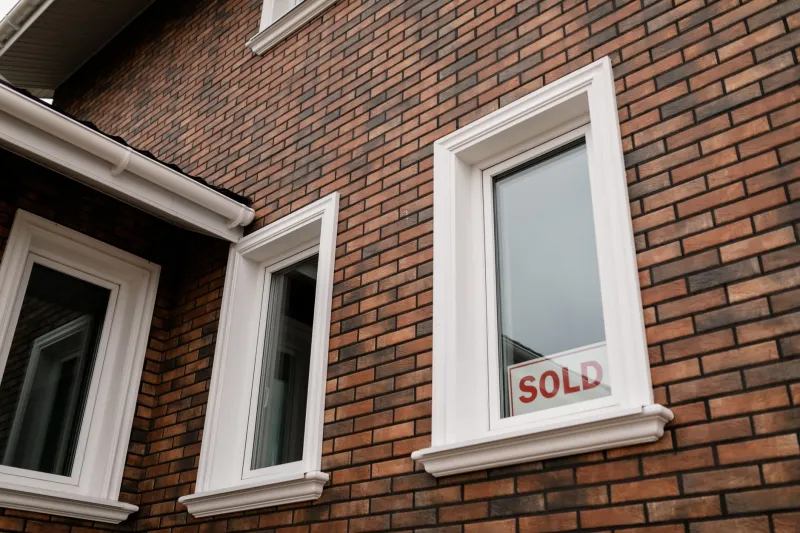
At its core, the strategy rests on a deceptively simple premise: if a property receives a new door number, a fresh coat of exterior paint in a shade approved by the Housing Delivery Taskforce Aesthetic Sub-Committee, and a set of estate agent photographs taken on a clear morning from a flattering angle, it may henceforth be classified as a new build for the purposes of the government's official delivery statistics.
Properties that additionally install a ring doorbell, replace a boiler with an identical boiler, or add a small herb planter to a windowsill will qualify for the enhanced designation of Premium New Delivery Unit, which carries additional weighting in the national housing ledger.
"We are doing something genuinely historic here," said Sir Geoffrey Plinth, the newly appointed Housing Delivery Champion, at a press conference held in a converted church hall in Westminster. "Previous governments looked at the housing crisis and asked, 'How do we build more homes?' We asked a better question: 'What is a home, really?' And then we asked a third question, which was 'Who decides what counts as new?' And that, frankly, is where things got exciting."
 Photo: Sir Geoffrey Plinth, via i.etsystatic.com
Sir Geoffrey was appointed to the role six weeks ago following a distinguished career in property consultancy, during which he successfully advised three successive governments on housing strategy without any of the resulting strategies producing a measurable number of houses.
Expert Commentary
The proposal has drawn warm praise from the Centre for Sustainable Residential Futures, a think tank based in a Georgian townhouse in Mayfair that has not visited an active building site since a fact-finding trip to a Barratt Homes development in Northampton in 1987.
"This is genuinely innovative thinking," said the Centre's Director of Housing Outcomes, Dr Penelope Voss, who delivered her remarks via video link from what appeared to be a very well-appointed kitchen. "For too long, we have been trapped by a narrow definition of 'new'. What Sir Geoffrey is proposing is essentially a philosophical reframing of the built environment. Which is, if anything, more durable than bricks."
Dr Voss added that the Centre would be publishing a full supporting analysis within the next six to eight months, pending the completion of an internal review into whether the analysis should be published as a white paper, a green paper, or a teal paper, which is apparently a thing now.
The Royal Institute of British Architects issued a statement describing the strategy as 'novel', which sources within the organisation confirmed was not intended as a compliment.
The Numbers
The government's own modelling suggests that the reclassification programme could generate up to 847,000 notional new homes in its first year alone, with the remainder achievable by the end of year two if local councils agree to extend the scheme to include properties where the owner has simply moved the furniture around.
A separate annex to the strategy, marked For Internal Optimism Only, notes that if loft conversions in progress, planning applications submitted but not yet approved, and houses that are 'broadly intended to be built at some point' are included in the figures, the government may actually exceed its 1.5 million target by as early as next spring.
The Treasury has confirmed it will not be providing additional funding for the programme, on the grounds that no new buildings are technically being constructed.
The Small Print
Opposition housing spokespeople have raised concerns, which Sir Geoffrey described at the press conference as 'understandable but fundamentally unimaginative'.
"The British people don't want to hear about planning reform, green belt designation, or infrastructure investment timelines," he said, consulting a card that appeared to have been written by someone else. "They want to hear that their government is delivering. And we are delivering. We are delivering the concept of homes. At scale."
Asked whether the plan would help first-time buyers who cannot afford to purchase any of the existing homes being reclassified as new ones, Sir Geoffrey said that a working group had been established to examine the question and would report back within the statutory period, which he declined to specify.
The press conference itself was held without incident, though a planning officer present in a personal capacity noted afterwards that the church hall venue has been the subject of an outstanding enforcement notice since 2015, relating to a change-of-use application that remains, in the official parlance, 'under active consideration'.
A spokesperson for the local authority confirmed that the application would be reviewed as soon as the relevant department had finished reviewing the procedure for reviewing applications of this type.
Construction of the 1.5 million homes is expected to begin shortly.