The Nodder: How One Backbencher Built a Twenty-Year Career Entirely in Other People's Peripheral Vision
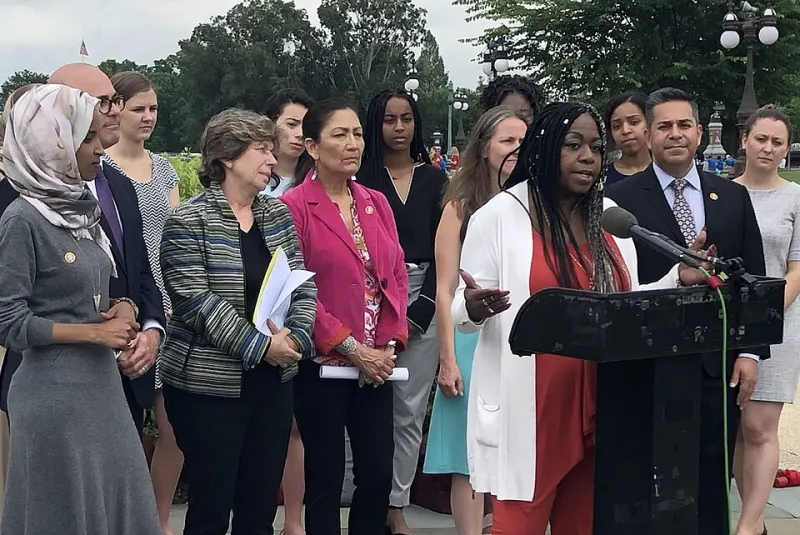
Photo: Deb Haaland, Public domain, via Wikimedia Commons
The Nodder: How One Backbencher Built a Twenty-Year Career Entirely in Other People's Peripheral Vision
There is a photograph, taken in October 2007, of the then-Chancellor announcing a package of infrastructure investment at a lectern in the Treasury's main briefing room. In the foreground: the Chancellor, looking assured. In the background, slightly left of centre, slightly out of focus, nodding with the measured solemnity of a man who has heard something he already agreed with: Colin Brace, MP for Shrewton Central.
 Photo: Shrewton Central, via shrewton.com
 Photo: Colin Brace, via d5nffgciuchtn.cloudfront.net
It is not the first photograph of this kind. It is, by the count of parliamentary archivist and enthusiastic amateur, Dr Terrence Goult, the forty-third.
By the time Colin Brace announced last month that he would not be standing at the next general election — an announcement made, fittingly, in the background of a press conference about something else entirely — he had accumulated what Dr Goult estimates to be 214 documented background appearances across four prime ministerial administrations, six party leaders, and one emergency statement about a badger cull that somehow required the physical presence of thirty-two backbenchers.
He has never introduced a piece of legislation. He has never served in government. He has, according to Hansard's word-frequency analysis tools, used the word "absolutely" in the chamber more than any other MP in the past fifteen years, always in agreement with whoever was speaking at the time.
Political analysts call it a career. Colin Brace calls it "just getting on with it."
A Timeline of Background Greatness
To understand the scale of Mr Brace's achievement, one must survey the landscape of his appearances.
2004: First recorded background appearance, behind the then-Trade Secretary at a manufacturing summit in Birmingham. Brace is partially obscured by a potted plant but his left shoulder is clearly visible, and his body language suggests engagement.
2008: Financial crisis press conference. Brace appears directly behind the Prime Minister, nodding at what journalists later identified as the precise moment the phrase "difficult decisions" was uttered. The nod is described by The Guardian's sketch writer as "unexpectedly moving."
2012: Olympic legacy announcement. Brace achieves what Dr Goult calls his "compositional peak" — centred, fully in frame, nodding with what parliamentary body language consultant Fiona Draper describes as "an almost architectural sense of occasion."
 Photo: Fiona Draper, via live.staticflickr.com
2016: Brexit referendum result. Brace appears in the background of no fewer than four separate television pieces to camera on College Green, each time with a different minister, each time nodding, each time wearing what appears to be the same blue tie. He is not interviewed on any occasion. He does not appear to have sought to be.
2019: Boris Johnson's first press conference as Prime Minister. Brace is in the third row, partially behind a taller colleague, but his distinctive nod — a slow, downward motion with a slight leftward tilt — is visible to those who know what to look for. Dr Goult has circled it in a printed photograph he keeps in a folder labelled, simply, Brace.
2023: Net zero strategy announcement. Brace achieves what is, to date, his longest sustained screen time: eleven seconds of uninterrupted nodding as the Secretary of State describes the government's commitment to offshore wind. A clip is briefly shared on political Twitter. The caption reads: "Who is this man and why does he look like he already knew?"
The Technique
Fiona Draper, who has consulted on parliamentary communications for fifteen years and teaches a module on non-verbal political signalling at a university she asked us not to name, agreed to analyse footage of Mr Brace for this article.
"What's remarkable," she said, watching a compilation on a laptop with the sound off, "is the restraint. Most background nodders overcorrect. They nod too vigorously, or they smile too broadly, or they look directly at the camera, which immediately marks them out as someone who wants to be seen. Brace never does any of that. He nods just enough to register as present and supportive, but not so much that he becomes the story. It's a very specific skill."
She paused the footage on a frame from 2015.
"Look at that. He's not even looking at the minister. He's looking at a point approximately eighteen inches above the minister's left shoulder. And yet the overall impression is of total engagement. That's not accidental. That's craft."
Dr Goult, who has written a 12,000-word essay on Mr Brace's career that has not yet found a publisher but which he is confident will, agrees. "Colin Brace understood something that most politicians don't," he told us. "Which is that proximity to power is a renewable resource, as long as you never try to use it. The moment you step forward and say something, you become accountable. The moment you stay back and nod, you become part of the furniture. And furniture, unlike ministers, has a very long shelf life."
The Constituents
In Shrewton Central, a market town constituency on the edge of Wiltshire, opinion of Mr Brace is warm, if imprecise.
"He's always there, isn't he," said one resident outside the local Co-op, who identified herself only as Margaret. "You see him on the telly. In the background. Nodding. It's reassuring, somehow."
Another constituent, a retired teacher named Alan, said he had voted for Mr Brace at every election since 2001 and felt he had done "a solid job," though when pressed to name a specific thing Mr Brace had done, Alan said he thought there'd been something about a bypass, which may have been the council.
Mr Brace held a constituency surgery every other Friday for nineteen years. Attendance records show a consistent turnout of between four and seven constituents per session. Notes from these surgeries, obtained under a Freedom of Information request, record that Mr Brace listened carefully to each concern raised, said he would look into it, and in several cases sent a follow-up letter describing what he had looked into, which was, in each documented instance, the process by which the relevant matter would be considered by the appropriate authority.
The Retirement Statement
Mr Brace's retirement was announced in a press release issued at 4:47pm on a Friday — a timing that political correspondents immediately recognised as deliberate — and was covered by three regional newspapers and briefly by the Press Association, whose wire item described him as "a long-serving backbencher and familiar parliamentary presence."
He did not hold a press conference. He did not appear on any political programmes. He did not post on social media. He issued a single statement, which read, in full:
"It has been the honour of my life to serve the people of Shrewton Central in Parliament. I have always believed in doing the job properly, quietly, and with a sense of purpose. I look forward to the next chapter, whatever form that takes, and I am grateful for the support I have received across twenty years of public service. There is much still to be done, and I know it will be done well."
The statement contains 72 words. It communicates, by Dr Goult's assessment, no specific information of any kind.
"It's perfect," he said, reading it for the third time. "It's the written equivalent of the nod. He's done it again."
Mr Brace was unavailable for further comment. He was, a spokesperson said, attending an event in support of a colleague's announcement. He would be in the background.