Cabinet Office Publishes Definitive Strategy for Fixing All Previous Definitive Strategies

The Cabinet Office has this week published Delivering Delivery: A Framework for the Reform of Reform, a landmark 340-page strategy document that promises to fundamentally transform the government's approach to fundamental transformation, in what senior officials are calling the most significant overhaul of overhauls since the last significant overhaul of overhauls in 2021.
The document, which was itself previewed in a pre-publication consultation document about the forthcoming document, sets out a clear and ambitious vision for how Britain will, over the next eighteen months, fix the mechanisms by which it was supposed to have already fixed everything.
"This is genuinely different," said Marcus Firth, the Cabinet Office's newly appointed Senior Delivery Champion, speaking from a glass-walled meeting room in which seventeen other people sat silently around a table bearing no paper whatsoever. "What we're doing here is taking a hard look at the delivery architecture of our previous delivery architecture, and asking ourselves: how do we build a more deliverable architecture for delivering the things we said we'd deliver when we built the last architecture?"
 Photo: Marcus Firth, via vicfirth.com
When asked to define what delivery, in this context, actually means, Mr Firth smiled warmly and said he was "very glad" the question had been raised.
The Document Itself
At 340 pages, Delivering Delivery is, by some margin, the longest strategy document produced to address a strategy document. Its executive summary alone runs to forty-one pages, and includes a note on page thirty-eight acknowledging that the executive summary may itself require a summary, which officials say will be published "in due course."
The framework is structured around six strategic pillars, each of which contains four delivery workstreams, each of which is supported by three enabling sub-frameworks, which together feed into a central Programme Board whose membership has not yet been confirmed but will be announced following a recruitment process that is currently at the scoping stage.
Chapter seven, titled Reforming Reform: A Reformed Approach, acknowledges that the 2021 strategy — Building Back Better Systems for Building Better Systems — did not achieve its stated objectives, before clarifying that this was partly because its stated objectives had not, technically, been stated in measurable terms. "The previous framework was deliberately aspirational rather than metric-driven," the document explains, "which allowed for a degree of flexibility in assessing outcomes that the new framework will seek to preserve, while also being more specific."
Critics have noted that this sentence contains a grammatical contradiction. The Cabinet Office has confirmed it is aware of this and considers it a feature.
Parliamentary Scrutiny
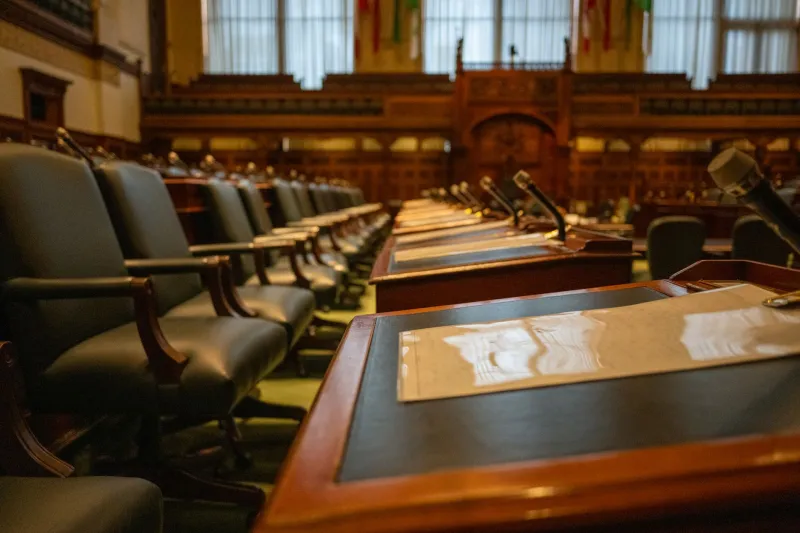
The strategy was presented to the Public Administration and Constitutional Affairs Committee on Tuesday, where it received what committee chair Dame Patricia Hollis described as "a thorough examination," by which she appeared to mean that several members asked questions and Mr Firth answered all of them at considerable length without providing any information.
 Photo: Dame Patricia Hollis, via c8.alamy.com
"Can you tell us," asked one backbencher, "what this strategy will look like in practice? Concretely. On the ground. In terms of things that actually happen."
"Absolutely," said Mr Firth. "That's precisely what the implementation roadmap addresses, and I'd point the honourable member to Annex D, which sets out the phased approach to operationalising the delivery architecture in a way that is both ambitious and realistic, and which we expect to have populated with specific milestones by the end of the next review period."
"And when is the next review period?"
"That's part of what we're currently scoping."
The committee noted the response and moved on.
Expert Opinion
Dr Helena Marsh of the Institute for Governmental Process Studies — itself a body established in 2017 to study the findings of a previous body established in 2014 — told The Daily Despatch that the framework represented "a meaningful step in the right direction, assuming the direction is correct, which the framework itself does not specify."
"What's interesting," she said, "is that this is now the fourth consecutive government strategy document to identify the previous government strategy document as the primary obstacle to progress. At some point, someone will have to reckon with the implication of that pattern. Probably in a future strategy document."
The think tank Reform Watch, which monitors government reform programmes, published a 200-page response to Delivering Delivery within forty-eight hours of its release. The response concluded that the framework was "broadly positive in intent," "structurally coherent at a high level of abstraction," and "likely to require further elaboration before implementation can meaningfully begin." The response also noted that it had identified seventeen areas requiring further review, and proposed the establishment of a working group to scope a consultation on each of them.
The Journey Ahead
The Cabinet Office has confirmed that Delivering Delivery will now enter a twelve-week public consultation period, after which responses will be analysed, synthesised, and used to inform a revised version of the document, expected in Q3, which will then be subject to a further targeted engagement exercise before a final version is submitted to ministers for approval.
Mr Firth said he was "genuinely excited" about this process. "For the first time," he told journalists, "we have a real plan. A plan with teeth. A plan that says: here is how we will fix what wasn't working. And I think people across the civil service, across government, across the country, will look at this and feel that sense of momentum."
The document is currently available as a PDF on the Cabinet Office website, listed under a subsection titled Current Strategies (Active), alongside fourteen other documents also listed as active, three of which predate the current government, and one of which references a department that no longer exists.
Officials confirmed the document will remain there until it is replaced by the next one, which is expected to be substantially more comprehensive.