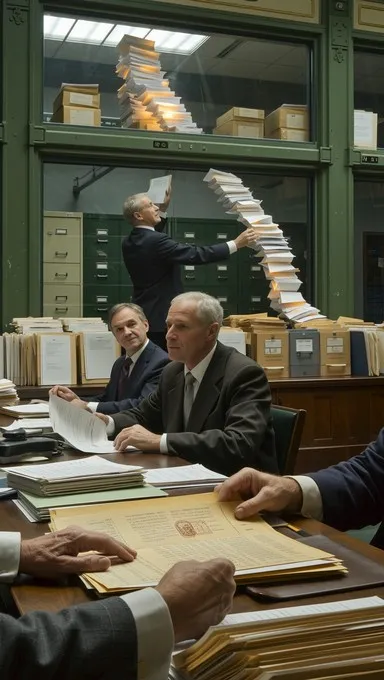
Nation Salutes Gerald Fothering CBE, the Man Who Attended 2,400 Meetings and Left No Trace
There is a particular kind of genius that Whitehall has always quietly nurtured — one that requires no discernible output, generates no controversy, and leaves behind it only a faint impression of competent solidity, like the outline of a man on a chair. Gerald Fothering CBE is, by universal consensus among those who worked with him, the finest living practitioner of this art.
Fothering retired last month after thirty-one years in the Senior Civil Service. He attended, by his own estimate, approximately 2,400 meetings. He served on forty-three committees. He was copied into roughly 180,000 emails. He produced, colleagues confirm, nothing that could be independently verified as his own work, idea, or opinion.
He received a CBE in the New Year Honours. The citation read: For services to public administration.
The Early Years
Gerald Fothering joined the Home Office in 1993 as a Higher Executive Officer, having completed a degree in History at the University of Leicester and a postgraduate diploma in something he describes, when pressed, as "administrative governance theory."
His first manager, now retired, recalls being immediately struck by Fothering's presence. "He was very much there," she said. "You always knew Gerald was in the room. He had a quality of — I want to say thereness. He was extraordinarily there."
When asked what Fothering actually contributed during this period, she paused for some time. "He was very thorough with his reading," she said eventually. "He always had the papers."
Fothering was promoted to Senior Executive Officer in 1997, Principal in 2001, and Grade 7 in 2004 — each elevation occurring, colleagues note, without any specific achievement that could be pointed to as its cause, and without any failure that might have interrupted it. He simply moved upward, steadily and without friction, like a well-oiled lift with no particular destination.
The Technique
Those who worked alongside Fothering across multiple departments speak of his methods with something approaching reverence, though they struggle to describe them in concrete terms.
"Gerald had a particular way of nodding," says one former colleague at the Department for Transport. "It wasn't an enthusiastic nod. It wasn't a sceptical nod. It was a considered nod. You'd finish making a point and Gerald would nod and you'd think: yes, someone serious has heard this. It was enormously validating. You'd leave the meeting feeling your contribution had been properly received."
"Did Gerald then do anything with what he'd heard?"
A long pause. "Not as such, no."
Another colleague, who served with Fothering on a cross-departmental digital transformation board for four years, recalls his contribution to a particularly heated debate about data migration protocols. "Gerald looked very concerned," she said. "He furrowed his brow in a way that suggested he appreciated the gravity of the situation. Then he said he thought it was 'worth reflecting on' and suggested the item be carried over to the next meeting. Which it was. And the one after that. And honestly, by that point, the project had been cancelled anyway, so in hindsight Gerald was completely right."
The Paper Trail
A Freedom of Information request submitted by this publication — purely in the spirit of thoroughness — sought any documents, briefings, or policy papers authored solely by Gerald Fothering during his career. The Cabinet Office responded after twenty days to confirm that no such documents could be located.
This is not, Fothering's former colleagues are at pains to stress, because he didn't work. He worked constantly. He attended everything. He replied to emails — always within twenty-four hours, always with a response that acknowledged the email's existence without advancing the matter it concerned. He contributed to documents by moving commas. He added his name to cover sheets. He reviewed things and confirmed they had been reviewed.
"Gerald was essential to the process," insists one senior official. "You couldn't have had the process without Gerald."
When asked what the process produced, the official said it was "a bit early to say."
The Testimonials
At Fothering's leaving party — held in a DEFRA meeting room, attended by forty-six colleagues, catered by the same sandwich company that has serviced every Whitehall leaving event since approximately 2003 — the tributes were warm, numerous, and strikingly uniform in their vagueness.
"Gerald was a safe pair of hands," said his final line manager, Director General Harriet Blount. "In thirty-one years, I never once worried about what Gerald was doing. And I think that says everything."
"Gerald always made you feel heard," offered a colleague from his time at the Ministry of Justice. "Whether or not anything happened as a result, you always felt heard."
"He had tremendous institutional memory," said a third. "He remembered every meeting. He just couldn't always remember what had been decided."
Fothering himself gave a short speech thanking colleagues, referencing the privilege of public service, and noting that the sector faced "real challenges ahead" that would require "thoughtful, collaborative responses from all parts of the system." The speech was warmly applauded. Nobody wrote anything down.
Legacy
Gerald Fothering is now available for non-executive board positions, advisory roles, and independent review panel appointments. His consultancy day rate has not been disclosed.
He has already been approached by two think tanks.