Council Spends £2.3m Discovering That Its Own Building Is, In Fact, Difficult to Enter
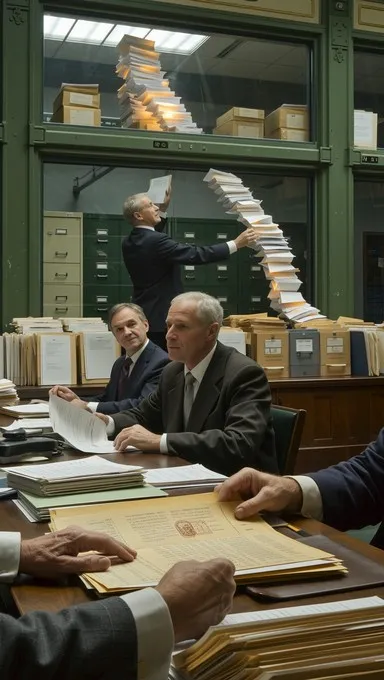
Brockfield Borough Council has this week published the long-awaited findings of its Accessibility and Inclusivity Built Environment Review — a three-year, £2.3 million investigation into whether the council's civic centre on Hartley Road is accessible to all members of the public.
The headline finding, presented across 214 pages, four appendices, two executive summaries (one of which summarises the other), and a glossy infographic pack described in the document as a "communications asset," is as follows: the building is not fully accessible.
Specifically, it is quite hard to get into.
This will come as news to nobody who has attempted to visit the Brockfield Civic Centre in the past decade, including the estimated 340 residents who submitted formal complaints about access between 2018 and 2021, all of which were logged, acknowledged, and filed under "Infrastructure — Ongoing."
The Building in Question
The Brockfield Civic Centre was built in 1974 and last substantively renovated in 2003, when the car park was resurfaced and a commemorative plaque was installed near the main entrance acknowledging the council's commitment to community service. The plaque is bolted to a wall that is, the report notes on page 47, "not clearly visible from the primary pedestrian approach route due to an obstructing privet hedge."
The building's accessibility challenges, as catalogued by the report, include: a passenger lift that has been out of service since November 2021 and is described in the document as "temporarily non-operational (extended)"; a wheelchair ramp installed in 2009 at a gradient that the report's authors delicately describe as "exceeding recommended parameters for independent navigation" and which a local disability campaigner, Sandra Okafor, has been describing as "basically a ski slope" since 2011; a set of automatic doors on the north entrance that open approximately sixty percent of the time; and a revolving door on the main entrance that has been jammed at a forty-degree angle since a delivery incident in February 2019.
Ms Okafor, who uses a powered wheelchair and has been raising these issues with the council since 2014, said she found the report "thorough." When asked if she meant that as a compliment, she said she did not.
The Methodology
The Review was commissioned in March 2021 and conducted by Meridian Access Consultancy Partners LLP, a firm whose website describes them as "leaders in the built environment inclusivity space" and whose founding director sits on the board of an organisation that advises councils on commissioning accessibility reviews.
The methodology, outlined across chapters three through seven, involved: a physical survey of the building conducted over four days in June 2021; a stakeholder consultation process comprising three focus groups, an online survey (127 responses), and eleven one-to-one interviews with "lived experience representatives"; a desktop review of relevant legislation and guidance; a benchmarking exercise comparing Brockfield Civic Centre against fourteen other council buildings; and a "gap analysis" identifying the distance between the building's current accessibility performance and what the report terms "the aspirational accessibility horizon."
The benchmarking exercise found that Brockfield's civic centre ranked twelfth out of fourteen. The two buildings it outperformed were, respectively, a Victorian town hall whose ground floor has been closed since a ceiling collapse in 2018, and a council annex that the report notes is "technically accessible but located seven miles from a bus route."
The Executive Summary
For those disinclined to read all 214 pages — and the report's authors appear to have anticipated this, producing an executive summary of thirty-one pages and then a summary of the summary at twelve pages — the key findings are presented as follows:
"The Brockfield Civic Centre presents a complex and multifaceted accessibility landscape in which areas of relative strength exist alongside significant opportunities for improvement across several dimensions of the user access journey."
Those "areas of relative strength" are, the report clarifies on page 23, the presence of a disabled parking bay (though it notes the bay is "frequently occupied by non-badge holders") and the fact that the building has a ground floor.
The "significant opportunities for improvement" include, among other things, fixing the lift, adjusting the ramp, repairing the doors, and unjamming the revolving door.
The cost of these four interventions is estimated in Appendix B at approximately £180,000.
The Recommendations
The report makes seventeen recommendations. Recommendations one through four concern the physical repairs outlined above. Recommendations five through seventeen concern governance, monitoring, reporting, and review processes to ensure that the council maintains its commitment to accessibility going forward.
Recommendation eleven proposes the establishment of an Accessibility Delivery and Oversight Sub-Committee. Recommendation twelve proposes that this Sub-Committee commission an annual accessibility audit. Recommendation thirteen proposes that audit findings be reported to the full council via a standing agenda item. Recommendation fourteen proposes that a resident accessibility panel be constituted to scrutinise the annual audit. Recommendation fifteen proposes that the constitution of this panel be subject to its own consultation.
Recommendation seventeen, the final one, recommends that the council commission a follow-up review in three years to assess progress.
The estimated cost of implementing recommendations five through seventeen is not provided. The report notes only that it represents "a proportionate investment in sustained accessibility governance."
The Response
Council leader Cllr Martin Pryce welcomed the report as "a landmark moment for Brockfield's commitment to inclusive public services" and confirmed that the council would be "carefully considering" its recommendations over the coming months.
When asked whether the revolving door would be fixed, a council spokesperson said the matter was "being assessed as part of the broader implementation planning process."
The door has been jammed since February 2019.
Sandra Okafor, who has been using the side entrance — which requires a staff member to unlock it manually — for the past six years, said she was glad the council now had the evidence it needed.
"They've spent £2.3 million," she said, "to confirm what I told them in an email in 2014. I'm not sure whether to be furious or impressed."
The council has set aside a further £40,000 for a communications campaign to publicise the report's findings to residents.
The revolving door remains at forty degrees.