Backbench MP Develops Passionate Love for Constituency He Has Represented for Fourteen Years, Effective Immediately

Gerald Fortescue-Marsh, the Conservative MP for Stannington Central, has this week emerged as an impassioned defender of his constituency's unique character, historic identity, and the profound bonds he shares with its residents. Mr Fortescue-Marsh has represented Stannington Central since 2010. The Boundary Commission proposed on Tuesday that it might give some of it to someone else.
 Photo: Stannington Central, via heatonstan.co.uk
The development has been described by political analysts as 'textbook,' by local councillors as 'rich,' and by Mr Fortescue-Marsh himself as 'a moment of genuine reckoning with what truly matters in public life.'
A Man Transformed
Prior to Tuesday, Mr Fortescue-Marsh's relationship with Stannington Central could be characterised, with some generosity, as periodic. Parliamentary records show he has spoken in the chamber on constituency matters eleven times in fourteen years, of which four occasions concerned planning disputes involving properties he later confirmed he had misidentified. He has attended 23% of local council meetings, a figure his office describes as 'reflective of the demands of national legislative work,' and which local councillors describe as 'generous.'
His constituency surgery, held on the third Friday of alternating months in a function room above the Crown and Anchor, has operated on what one caseworker called 'an appointment system that functions more as a suggestion.' His last visit to the Stannington North food bank was in 2019, for a press photograph following a donation drive he did not personally organise.
All of this changed at approximately 11.47am on Tuesday, when the Boundary Commission published its provisional proposals.
By 2pm, Mr Fortescue-Marsh had issued a 600-word statement describing Stannington Central as 'the beating heart of everything I hold dear.' By 4pm, he had announced an emergency surgery open to all constituents, to be held this Saturday. By 6pm, his office had released a photograph of him standing outside the food bank, which was closed.
The Statement
The statement deserves some attention. In it, Mr Fortescue-Marsh describes Stannington Central as 'a community forged in the fires of shared endeavour,' references 'the proud history of the Stannington market square' (the market was closed in 2017 following a dispute with the council he did not attend), and speaks movingly of 'the extraordinary people I have had the privilege of serving, whose resilience and spirit have been a constant inspiration.'
 Photo: Stannington market square, via media.onthemarket.com
When this publication contacted Mr Fortescue-Marsh's office to ask how many of those extraordinary people he could name without prompting, a spokesperson said the MP was 'currently in the constituency engaging directly with residents' and would respond in due course.
Mr Fortescue-Marsh was, at the time of this enquiry, photographed at a service station on the M1 approximately forty miles from Stannington Central. His office confirmed he was 'en route.'
The Pothole Column
Perhaps most striking is the opinion piece Mr Fortescue-Marsh published in the Stannington Courier on Wednesday morning, under the headline 'Our Roads, Our Rights, Our Community.' In it, he describes the state of local roads as 'a scandal that has gone on for too long' and calls on the council to 'act with urgency on this critical infrastructure issue.'
The Stannington Courier's editor, Janet Pryce, confirmed that this was Mr Fortescue-Marsh's first unsolicited submission to the paper since a letter about parking charges in 2016. She also noted that the MP had voted against the local infrastructure funding amendment in 2021 that would have provided the council with additional road repair budget, a detail she included in an editor's note beneath the column.
Mr Fortescue-Marsh's office described the editor's note as 'unhelpful and politically motivated.' Ms Pryce described it as 'accurate.'
Community Spirit, Rediscovered
By Thursday, Mr Fortescue-Marsh had visited a primary school, attended a community litter pick he had not been invited to, and announced plans for a 'Stannington Central Futures Forum' at which residents could share their vision for the constituency's development. He also appeared on local radio, where he described the boundary proposals as 'an assault on the very fabric of what makes this place special.'
The host asked him to name the ward most affected by the proposed changes. There was a pause of several seconds. Mr Fortescue-Marsh said he would 'want to be accurate on that' and would confirm in writing.
His office later confirmed the ward was Stannington Moor East. The host noted that Mr Fortescue-Marsh had referred to it throughout the interview as 'the eastern bit.'
Experts Observe
Dr Carolyn Hewes, a political scientist at the University of the Midlands who studies representative behaviour, said the pattern was 'entirely consistent with the literature.' 'We see this repeatedly,' she explained. 'A boundary review functions as a kind of administrative defibrillator. MPs who have been clinically inactive for years suddenly exhibit remarkable vital signs. Surgeries are scheduled, columns are written, food banks are visited. The effect typically lasts between six and eighteen months, depending on the outcome of the review.'
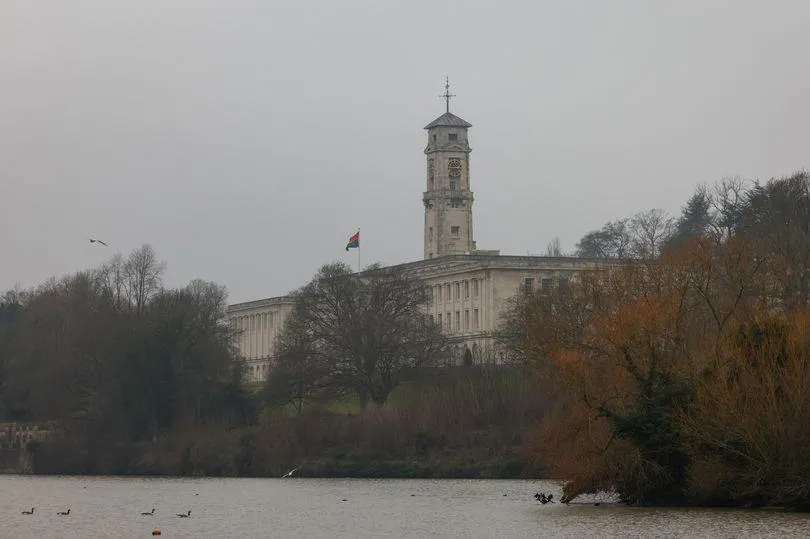 Photo: University of the Midlands, via img-s-msn-com.akamaized.net
She added that her research suggested the food bank visit was usually the first indicator. 'It's the clearest signal,' she said. 'You can almost set your watch by it.'
The Boundary Commission, Unmoved
The Boundary Commission confirmed this week that it had received 847 representations in the first 48 hours following publication of its Stannington proposals, of which 612 appeared to have been submitted using a template circulated by Mr Fortescue-Marsh's office. The Commission noted that all representations would be considered on their merits and that the process would continue in accordance with its established timetable.
Mr Fortescue-Marsh described the Commission's statement as 'tone-deaf to the democratic will of this community' and announced he would be raising the matter in Parliament.
It will be his twelfth constituency contribution in fourteen years.